
Gemini 4 Neon
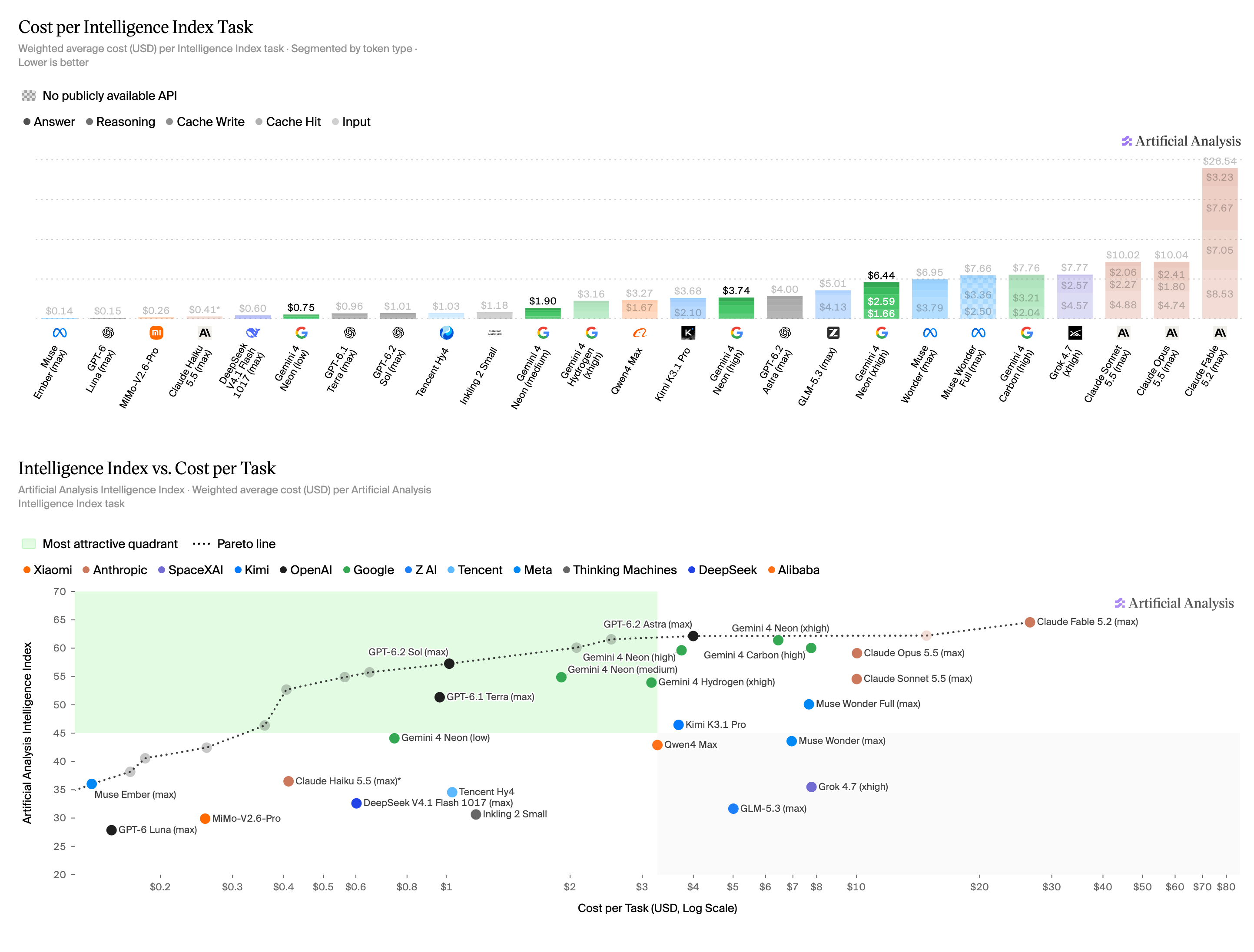
Neon matches Carbon's rounded Intelligence Index at high effort and edges ahead at xhigh. The larger change is in the cost and time needed to reach that result—with a pricing caveat while Carbon is discounted.
Gemini 4 Neon is available on MiniRouter as . The model page has current pricing, provider routes and API setup.
High captures most of the aggregate gain
Start with the effort setting, because it changes the comparison. At high, Neon and Carbon both score 60 on the Artificial Analysis Intelligence Index. Neon reaches 61 at xhigh. Those are rounded composite scores, not a percentage of tasks solved or a guarantee that the models have the same strengths.
Intelligence Index
- Neon low44
- Neon med.55
- Neon high60
- Neon xhigh61
- Carbon high60
0–70 points · higher is better
Benchmark cost per task
- Neon low0.75
- Neon med.1.9
- Neon high3.74
- Neon xhigh6.44
- Carbon high7.76
0–8 USD · lower is better
Carbon uses standard, non-promotional rates. These benchmark costs are not MiniRouter prices.
View chart data
| Model and effort | Index points | USD per task |
|---|---|---|
| Neon low | 44 | $0.75 |
| Neon medium | 55 | $1.90 |
| Neon high | 60 | $3.74 |
| Neon xhigh | 61 | $6.44 |
| Carbon high | 60 | $7.76 |
Moving from high to xhigh raises Neon's benchmark cost by 72%, from $3.74 to $6.44, for one additional rounded index point. That makes high a useful starting point for evaluation. Reserve xhigh for tasks where extra reasoning produces a result you can verify: a passing test, a recovered edge case or a better-supported conclusion.
Low and medium offer a different tradeoff. Their lower cost accompanies a substantial drop in the aggregate score. For a repeated workflow, compare cost per accepted result: inexpensive attempts that need repair can erase the saving.
A faster task can still start with a long wait
Neon's estimated task time is much shorter than Carbon's in this workload. But an interactive application also needs to account for the pause before the answer begins. High takes about 41 seconds to produce its first answer token; xhigh takes about 57.
Estimated time per Intelligence Index task
- Neon low3.7
- Neon med.8.3
- Neon high14.8
- Neon xhigh21.5
- Carbon high36.6
0–40 minutes · lower is better
View chart data
| Model and effort | Estimated minutes/task | Seconds to first answer |
|---|---|---|
| Neon low | 3.7 | 13.93 |
| Neon medium | 8.3 | 20.14 |
| Neon high | 14.8 | 40.64 |
| Neon xhigh | 21.5 | 56.51 |
| Carbon high | 36.6 | 72.86 |
For a background code review, total completion time may matter most. For a chat interface, the first-answer delay may dominate the experience. Measure both on representative prompts, and include tool execution and retries when measuring your own workflow.
Carbon's promotion changes the cost comparison
The $6.44 versus $7.76 comparison makes Neon xhigh about 17% cheaper per benchmark task. It uses Carbon's standard rates. On 19 November, Carbon is still discounted: Google lists $2 input and $10 output per million tokens through 30 November, rising to $4 and $20 from 1 December. Neon lists $3 and $15.
At the publisher's token rates, Neon is therefore 50% more expensive than promotional Carbon and 25% less expensive than standard Carbon. A lower token price is only one part of the bill; the number of reasoning tokens, cache reuse and repeated attempts also matter.
For perspective, halving Carbon's standard input, output and cached-input rates would reprice the same $7.76 workload to $3.88. That is a calculation holding usage fixed, not another benchmark run or a MiniRouter quote. It puts Neon high's $3.74 much closer to promotional Carbon than the headline saving suggests.
Sources: Google pricing, read 19 November 2026 and AA's launch analysis. See current MiniRouter prices →
Coding results compare complete agents
Artificial Analysis reports a Coding Agent Index of 59 for Antigravity CLI with Neon xhigh, versus 58 for Claude Code with either Opus 5.5 max or Fable 5.2 xhigh. The larger separation is their API-equivalent cost per task.
Coding agent cost per task
- Neon6.86
- Opus 5.512.61
- Fable 5.215.47
0–16 USD · lower is better
Neon: Antigravity CLI, xhigh. Opus 5.5: Claude Code, max. Fable 5.2: Claude Code, xhigh.
View chart data
| Model | Agent and effort | Coding Agent Index | USD per task |
|---|---|---|---|
| Neon | Antigravity CLI · xhigh | 59 | $6.86 |
| Opus 5.5 | Claude Code · max | 58 | $12.61 |
| Fable 5.2 | Claude Code · xhigh | 58 | $15.47 |
These results make Neon worth testing for an automated coding workflow, but they do not isolate the model. Tool access, context management and the agent's instructions can affect both success and token use. Replacing the model in your own agent does not reproduce the benchmark configuration.
More reasoning does not win every task
Document work gives a concrete counterexample to the aggregate ranking. On GDP.pdf, Neon high scores 33.4%, ahead of both Neon xhigh and Carbon high. An extra reasoning budget can help one class of work without improving another.
GDP.pdf · task success
- Neon high33.4%
- Neon xhigh28.0%
- Carbon high28.4%
0–100% · higher is better
View chart data
| Model and effort | Task success |
|---|---|
| Neon high | 33.4% |
| Neon xhigh | 28.0% |
| Carbon high | 28.4% |
AA-Briefcase adds a different signal: Neon xhigh records 1700 Elo overall and 1771 for presentation quality, compared with Sonnet 5.5 max's 1726 presentation rating. Elo describes relative judged performance; it is not a success percentage. A polished deliverable still needs its calculations and evidence checked.
These are evaluations of the wider model. MiniRouter's current Neon route accepts text, so the PDF result does not establish image or PDF-input support here. AA results · Briefcase methodology
Build the evaluation around your agent
Google's SWE-sweep results show how much the surrounding agent can matter even with the same Neon model. Antigravity includes parallel subagents, but this comparison changes the whole harness; it does not establish how much of the gain comes from that feature alone.
SWE-sweep · Gemini 4 Neon
- Mini-SWE12.8%
- Antigravity39.0%
0–100% · subtask-weighted reward
View chart data
| Harness | Subtask-weighted reward |
|---|---|
| Mini-SWE | 12.8% |
| Antigravity | 39.0% |
Start with a small set of tasks from your actual workload and a fixed acceptance rule. Keep prompts, tools and context handling constant while comparing high with xhigh. Record accepted results, total token cost, first-answer delay and completion time, including failed attempts. Then change the agent separately so you can tell which improvement helped.
Try Neon on your own task
Create a MiniRouter API key and set it as MINIROUTER_KEY. This route currently accepts text input and returns text. A small output limit can still require a large temporary balance hold.
curl https://api.minirouter.sh/v1/chat/completions \
  -H "Authorization: Bearer $MINIROUTER_KEY" \
  -H 'Content-Type: application/json' \
  --data '{
    "model": "google/gemini-4-neon",
    "reasoning": { "effort": "high" },
    "max_tokens": 8192,
    "messages": [{ "role": "user", "content": "Review this migration plan for failure modes: add a nullable column, backfill rows, then require the column." }]
}'Keep exploring
Compare published results in the model rankings and coding benchmarks, or read more model releases.
For MiniRouter product updates, visit the changelog.
Sources
- Read at Google DeepMind ↗
Gemini 4 Neon model card
Published Nov 18, 2026
- Read at Google ↗
Introducing Gemini 4 Neon
Published Nov 18, 2026
- Read at Google DeepMind ↗
Gemini 4 Neon evaluation methodology
Published Nov 18, 2026
- Read at Google ↗
What's new in Gemini 4 Neon
Published Nov 18, 2026
- Read at Artificial Analysis ↗
Gemini 4 Neon effort measurements
Published Nov 19, 2026
- Read at Artificial Analysis ↗
Gemini 4 Neon launch analysis
Published Nov 18, 2026
- Read at Google ↗
Gemini API pricing
Published Nov 10, 2026
Editorial reference revised 2026-11-19. Catalog status comes from the generated routing snapshot.